What is a Titanium Anode (Complete Guide)

A titanium anode is a type of electrode in electrochemical systems, where titanium (or titanium alloy) serves as the substrate for the anode. Thanks to its unique material properties and the use of advanced coatings, titanium anodes are widely used in industries such as water treatment, electroplating, chlor-alkali production, cathodic protection, and more.
1. Definition and Basics
1.1 What is an Anode?
In an electrochemical system, the anode is the electrode at which oxidation occurs (loss of electrons). In many industrial applications, the anode must conduct current, resist corrosion, catalyze or support electrochemical reactions, and maintain structural integrity under harsh conditions.
1.2 What is a Titanium Anode?
A titanium anode is an anode that uses titanium metal or a titanium alloy as the base substrate. Often, the titanium substrate is coated with a mixed metal oxide (MMO) or noble-metal coating to provide better catalytic performance, corrosion resistance, and longevity. Thus, a titanium anode typically comprises a substrate of commercially-pure titanium (often Grade 1 or 2) or a titanium alloy, and a surface coating such as ruthenium oxide, iridium oxide, platinum, or iridium-tantalum oxide. Because of this combination, titanium anodes are sometimes referred to as “dimensionally stable anodes (DSA)” when coated with MMO.
1.3 Why Use Titanium?
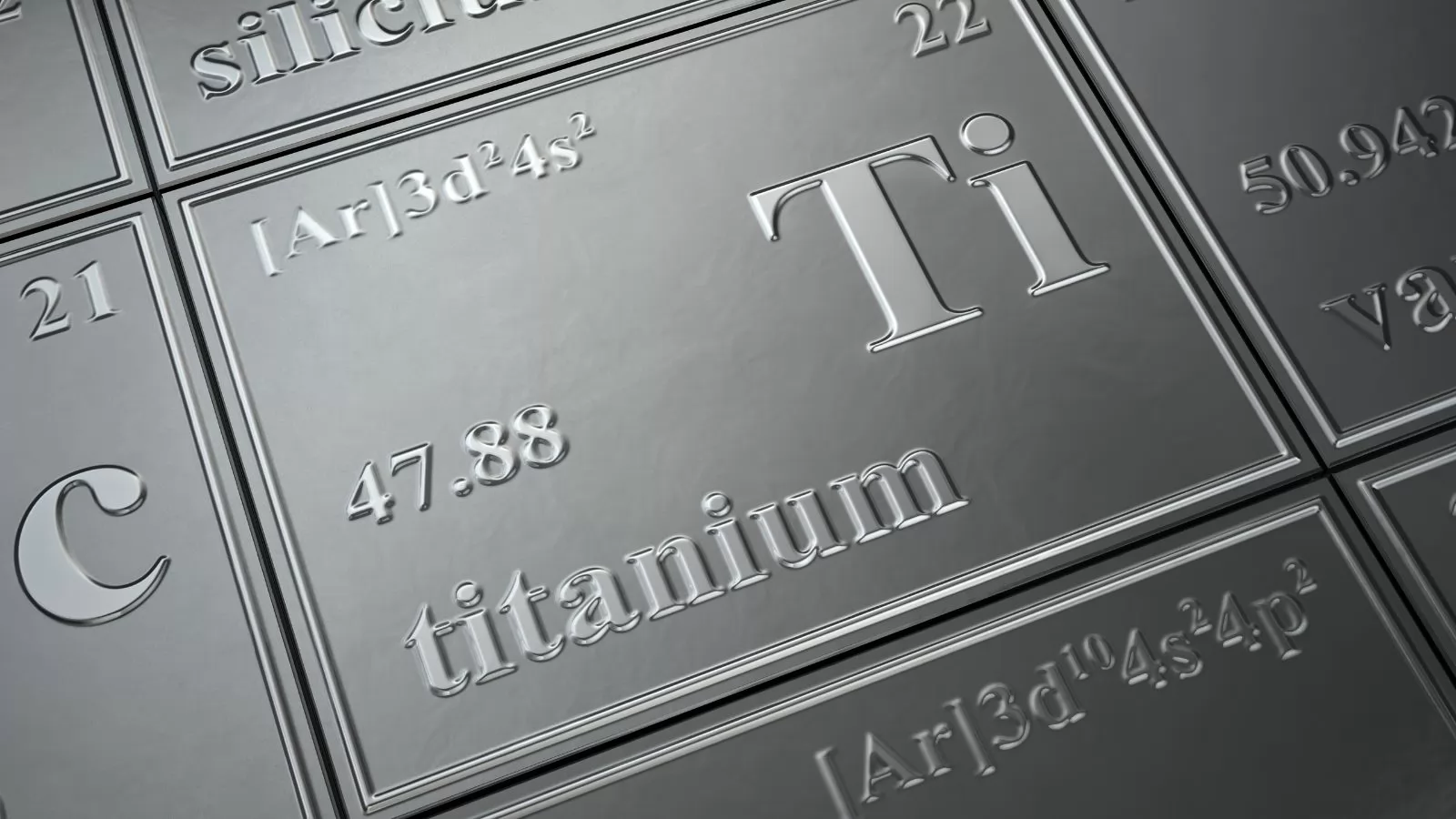
Titanium offers several key advantages: excellent corrosion resistance, good mechanical strength, light weight, and the ability to serve as a durable electrode substrate when properly coated. Commercially pure titanium is readily available, has excellent adherence when properly surface-prepared, and maintains high chemical resistance.
2. Materials and Coatings
2.1 Substrate Material
The substrate is usually commercially pure titanium, typically Grade 1 or Grade 2. These grades offer a good combination of conductivity, corrosion resistance, and processability. Sometimes titanium alloys may be used; however, pure titanium is most common for anode substrates.
2.2 Coatings: Mixed Metal Oxide (MMO) and Noble Metals
Because bare titanium substrate can form an insulating oxide or degrade in some environments, coatings are applied. Key types include:
- Ruthenium-based MMO coatings (RuO₂, Ru/Ir oxide mixtures) for chlorine evolution environments.
- Iridium-based MMO coatings (IrO₂, Ir/Ta oxide) for oxygen-evolution environments.
- Platinum or platinum-group coatings for high-performance applications.
These coatings provide high electrocatalytic activity, reduce overpotential for gas evolution, and enhance lifetime and stability.
2.3 How Coatings Work
The coating acts as the active catalytic surface for the electrochemical reaction, protects the titanium substrate from direct electrolytic attack, and maintains electrical conductivity. It also ensures dimensional stability so that the anode does not change shape or dissolve significantly over time.

3. Working Principle
3.1 Electrochemical Principle
When used in an electrolytic system, the titanium anode acts as the positive electrode. At the anode surface, oxidation reactions occur, such as chlorine or oxygen evolution, depending on the process. The substrate provides the structural and conductive foundation, while the coating provides the catalytic surface and protection. Current flows from the power supply to the anode, through the electrolyte, to the cathode.
3.2 Role of Coatings in Reaction
The coating lowers the overpotential required for the desired reaction, improving efficiency. It also prevents degradation or passivation of the titanium substrate, enhancing longevity and reliability.
3.3 Different Reaction Environments
- Chlorine evolution environments (e.g., brine electrolysis) require ruthenium-based coatings.
- Oxygen evolution environments (e.g., water treatment) require iridium-based coatings.
- Mixed environments may use dual-function coatings capable of handling both reactions effectively.
4. Manufacturing Process
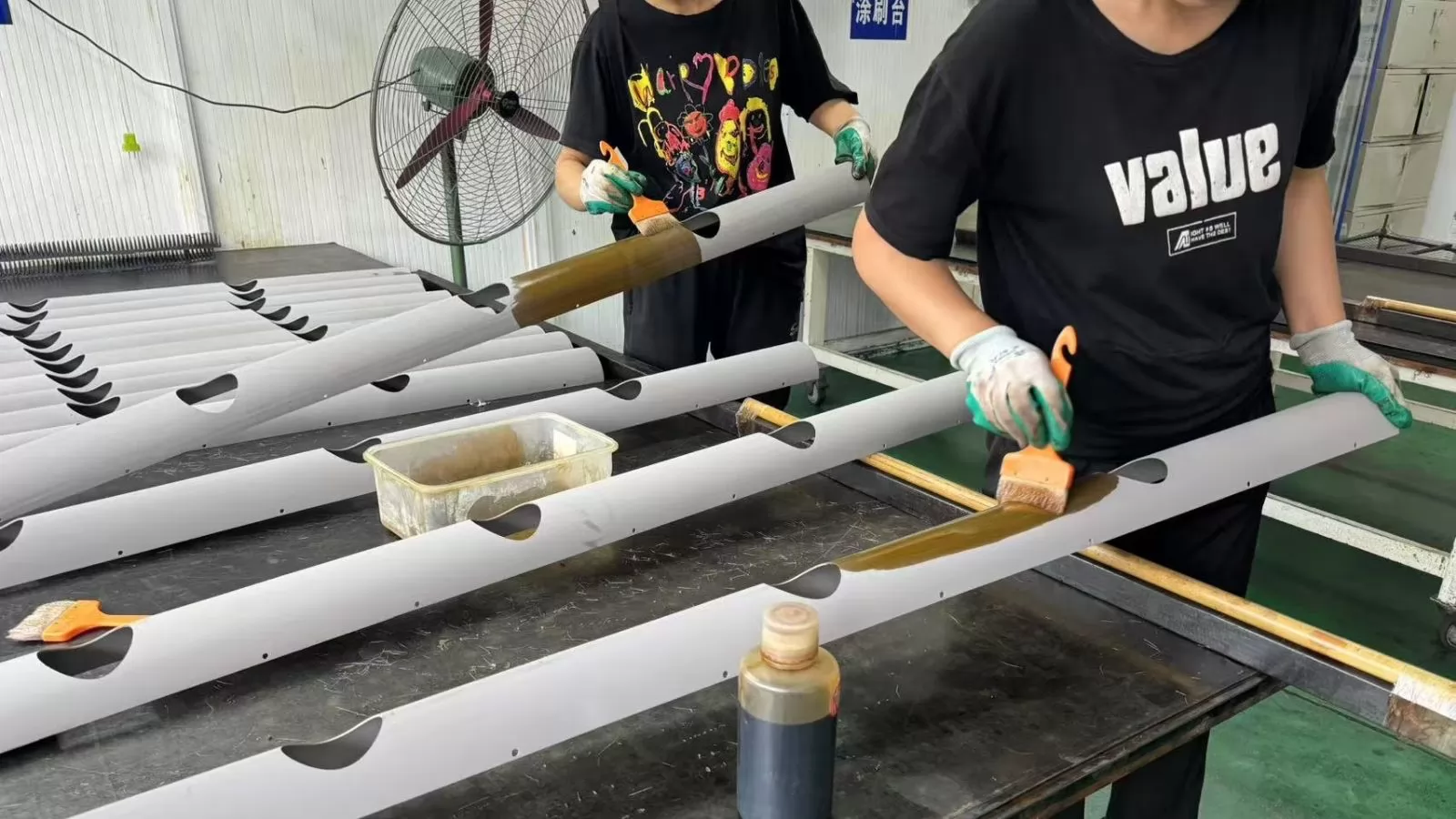
- Substrate preparation: Titanium plates, meshes, or rods are cut, cleaned, and surface-prepared to ensure good adhesion of the coating.
- Coating application: Metal-salt solutions are applied to the substrate, followed by thermal decomposition (typically 400–600 °C) to form a bonded oxide layer.
- Inspection and testing: The coated anode is checked for coating uniformity, adhesion, and conductivity.
- Finishing and packaging: The anode is labeled, packaged, and prepared for installation.
5. Key Advantages of Titanium Anodes
- Excellent corrosion resistance in acidic, alkaline, or seawater environments.
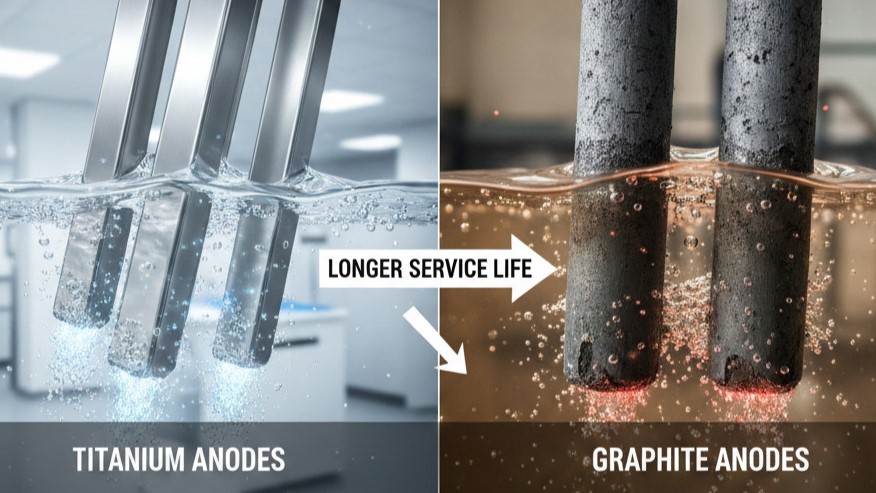
- Long service life due to insoluble and stable coating structures.
- Lightweight, strong, and easily formed into various shapes.
- High efficiency and low energy consumption due to reduced overpotential.
- Customizable in size, shape, and coating for different industrial needs.
- Environmentally friendly replacement for lead or graphite anodes.
6. Major Application Areas
6.1 Water Treatment and Disinfection
Used in electrochlorination, electrocoagulation, and electro-oxidation systems to generate oxidants that remove organics and disinfect water.
6.2 Electroplating and Metal Finishing
Titanium anodes provide stable current and resist corrosion, avoiding contamination of plating baths compared with graphite or dissolving anodes.
6.3 Chlor-Alkali Industry
Standard electrodes in the production of chlorine, caustic soda, and related chemicals due to high corrosion resistance and long lifetime in brine environments.
6.4 Cathodic Protection and Marine Applications
Used in cathodic protection systems for pipelines, tanks, and offshore structures, offering long-lasting corrosion resistance.
6.5 Electrowinning and Electrometallurgy
Titanium mesh or plate anodes are used in the electrowinning of metals like copper or nickel, providing improved efficiency and reduced by-products.
6.6 Emerging Applications
Applied in organic electrosynthesis, advanced oxidation processes, and seawater electrolysis for hydrogen production.
7. How to Select and Design a Titanium Anode
7.1 Key Selection Criteria
- Operating environment: electrolyte type, temperature, and pH.
- Coating type: match coating to reaction type (chlorine or oxygen evolution).
- Substrate quality: ensure high-purity titanium and good adhesion.
- Geometry: plate, mesh, tubular, or rod based on cell design.
- Service life and maintenance: estimate lifespan and recoatability.
- Energy efficiency: select coatings with lower overpotential.
7.2 Design Considerations
- Ensure uniform current distribution to avoid localized wear.
- Control temperature and fluid flow around the anode.
- Design for easy replacement or recoating of substrates.
- Optimize coating thickness for high current density applications.
8. Challenges and Future Trends
8.1 Challenges
- High cost of precious-metal coatings.
- Risk of coating failure if surface preparation is inadequate.
- Environmental regulations requiring safer electrode materials.
- Complex reaction environments demanding versatile coatings.
8.2 Future Trends
- Development of cost-effective and low-precious-metal coatings.
- Use of nanostructured coatings for higher catalytic activity.
- Recycling and reuse of titanium substrates.
- Adoption in renewable-energy electrolysis and green hydrogen systems.
- Smart monitoring for performance and lifespan prediction.
9. Summary and Key Takeaways
A titanium anode uses a titanium substrate, often coated with mixed metal oxides or noble metals, to serve as a durable and efficient anode in electrochemical systems. It combines the corrosion resistance of titanium with the catalytic and stability benefits of coatings. Titanium anodes are used in water treatment, electroplating, chlor-alkali, cathodic protection, and electrowinning. Proper selection and design ensure optimal performance, long service life, and cost-effectiveness.
10. Conclusion
Titanium anodes represent the next generation of high-performance, environmentally friendly electrode materials. Their strength, efficiency, and adaptability make them indispensable across modern electrochemical industries.
Need Help? We're Here For You!
0
Comments
Leave a Comment
Your email address will not be published. Required fields are marked *
Name can't be empty
Email error!
Message can't be empty
😍
😜
😳
😌
😄
😘
😝
😒
😃
😚
😚
😛
😟
😧
😀
😉
😓
😱
😤
😣
😂
😥
😩
😠
😢
😭
😰
😨
😡
😆
😪
😅
😐
😇
😋
😴
👿
😕
😏
😷
😵
😟
😮
😯
😑
👧
👴
😧
😬
😾
👶
👱
👵
👸
🙀
👺
👦
👩
👨
😽
😿
🙈
💩
💥
💤
😼
😹
🙉
🔥
✨
💦
👎
✌
👆
👈
💪
💹
👍
👊
💴
💶
💷
💸
👉
💵
🙏
🌎
🏧
👏
💳
👇
💑
🙆
🙅
💁
👫
👭
🙎
🙇
👑
👔
Submit Comment
Most Popular
-
 Oct 29, 2025What is a Titanium Anode (Complete Guide)
 -
 Dec 19, 2025Titanium Anode Lifespan Testing: How to Accurately Predict Service Life
 -
 Dec 25, 2025Titanium Anodes vs Graphite Anodes: Service Life and Cost Analysis
 -
 Dec 17, 2025MMO Coated Titanium Anodes vs Traditional Anodes: Complete Comparison


Laster Blogs
-
 Jan 22, 2026PCB Circuit Board Plating: Titanium Anode Applications in Practice
 -
 Jan 13, 2026Automotive Parts Plating: How Titanium Anodes Significantly Enhance Coating Quality and Performance
 -
 Jan 05, 2026Electrochemical Solutions for Hospital Wastewater Treatment
 -
Dec 25, 2025Titanium Anodes vs Graphite Anodes: Service Life and Cost Analysis


Set A Consultation Today
Name can't be empty
Email error!
Send Your Message
*We respect your confidentiality and all
information are protected.
